 by
NORMAN, Okla. – On Saturday at Gaylord Family–Oklahoma Memorial Stadium, Oklahoma made sure the day was about more than kickoff.
The university hosted its Native American Heritage Appreciation Day as the Sooners faced South Carolina, and the point of the event was representation, partnership, and visibility. OU Athletics worked with tribal entities including the Osage Nation Foundation and the Pawnee Nation of Oklahoma on special ticket offers, with portions of those sales supporting tribal foundations. That is the kind of detail that matters if the day is going to be more than a theme on a pocket schedule. It tied attendance to actual support.
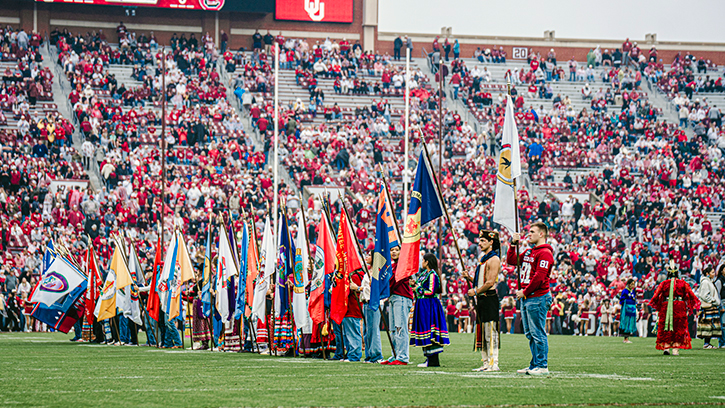
The strongest visual came before the game, when student and community volunteers brought all 39 federally recognized Tribal Nations of Oklahoma onto the field through their flags. That tradition has become a cornerstone of the partnership between the American Indian Student Association and the athletic department, and it still hits the way it is supposed to.
Oklahoma is home to 39 federally recognized tribal nations. Putting every one of those flags on the field is a simple act with a lot of weight. It says the university is not picking and choosing which communities get acknowledged for convenience. It is recognizing the full map.
That is a big deal especially in a football environment where Native representation is still rare at the FBS level.
Oklahoma has one known Native American player on the current roster in offensive lineman Kenny Wermy. The 6-foot-5, 315-pound local product from Cache wears No. 61 and arrived in Norman in 2023 as a preferred walk-on. Wermy is a registered citizen of the Comanche Nation and also represents the Northern Arapaho Tribe of Wyoming and the Southern Cheyenne of Oklahoma. Growing up in a community tied tightly to Comanche history, he has carried that identity with him while fighting for a place on the offensive line.
What stands out about Wermy is that he has not treated the jersey as the whole story. He has used the platform to go back into tribal communities, host sports camps, talk about school, and show younger Native athletes that major-college football is not closed off to them.
In a sport that still does not produce enough of those examples, that counts.
Representation is not only about who gets introduced on Saturday. It is also about who younger kids can point to during the week.
The day also stretched beyond the roster. Several members of OU’s RUF/NEKS crew brought their own tribal ties into the stadium culture around the program, including Carson Pendley (Potawatomi), Nivy Yarholar (Comanche, Mvskoke, Seminole, Cheyenne & Arapaho), Averie Mitchell (Choctaw), Clare Bebout (Choctaw), Alli Shew (Cherokee), and Bri Howard (Choctaw). Those details matter because heritage days are stronger when they reflect the wider university community, not just the players under the lights.
Oklahoma’s broader football pipeline has produced that kind of representation at the next level too.
With the Kansas City Chiefs, former Sooners Creed Humphrey and James Winchester have carried Oklahoma tribal identities onto championship rosters. Humphrey, a citizen of the Citizen Potawatomi Nation from Shawnee, has become one of the NFL’s best centers and a multi-time Pro Bowler and All-Pro. Winchester, a citizen of the Choctaw Nation of Oklahoma, has been a fixture at long snapper since 2015 and has the Super Bowl rings and American Indian Athletic Hall of Fame recognition to show for a career built on durability and trust. Together, they are an uncommon pair: two former Oklahoma players, both with Oklahoma tribal citizenship, contributing to the same organization at a championship standard.
That is why a day like Saturday still has value even when the focus stays on the event instead of the final score. The flags, the tribal partnerships, the ticket support, the student involvement, and the people tied to the program all point the same direction.
Oklahoma is in a position to do this in a way that is specific to the state and the communities actually connected to the university.
Native American Heritage Appreciation Day worked best when it stayed rooted in that reality. Not as a side note to football, but as a public reminder of who is represented in the building and who the university is choosing to recognize out loud.
